
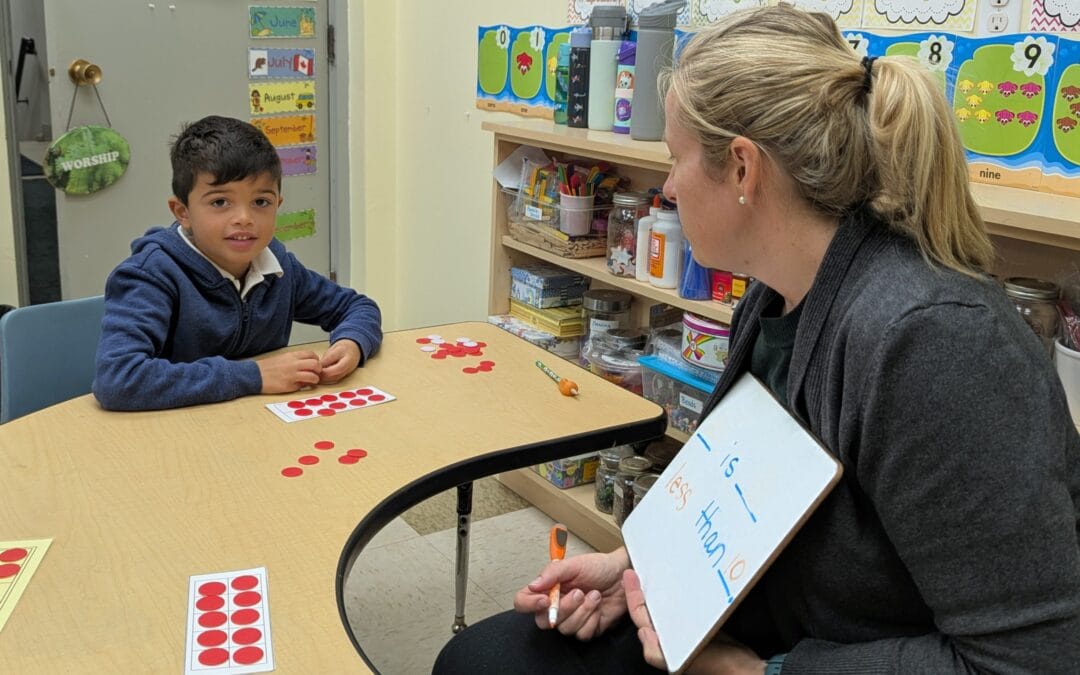
What does learning look like when two grades share a classroom? A closer look inside our Grade 1–2 classroom!
At Olivet School, it isn’t unusual to find two grade levels learning together in the same classroom. These are often called split-grade or combined-grade classrooms, and we have found them to be a wonderful learning environment for both students and teachers.
Having multiple grades in one classroom offers some unique advantages. Older students naturally become role models for younger classmates, helping new students learn classroom routines, expectations and school culture. Younger students benefit from having experienced classmates to look up to, while older students have opportunities to develop leadership, patience and confidence.
But what does this actually look like when it comes to teaching the curriculum? Let’s step inside our Grade 1–2 classroom to find out!
How Does It Work During Math?
Subjects like mathematics build upon concepts learned in previous grades, so Grade 1 and Grade 2 students receive instruction appropriate to their individual grade level.
Areas of the Grade 1 and 2 math curriculums overlap often and the teacher carefully aligns those units and lessons to deliver them to the full group. For example the 2D geometry unit has both grades counting sides and corners, but the Grade 2 students learn corners are “verticies”. Also additional shapes beyond the curriculum are taught to the full group, with the specific intention of the higher level students learning them, but also giving the younger students an opportunity to be exposed to the higher concepts.
When the curriculum does not overlap, the teacher organizes the period into alternating teaching and independent work times and changes daily which grade receives the lesson first.
Here’s how a math lesson with a non-overlapping unit might unfold:
- One group works independently while the other learns.
The teacher begins by giving each grade clear instructions for the lesson. The older students start by working on concepts they have already learned, while the younger students meet with the teacher to receive direct instruction on the day’s new lesson.
- Practice and immediate feedback.
As the Grade 1 students work through their lesson and accompanying workbook activities, the teacher checks their understanding and provides immediate feedback.
When the Grade 2 students finish their independent work, they move on to specially selected early finisher activities. These activities reinforce the math concepts they are currently learning and provide meaningful practice rather than simply keeping students busy.
- The groups switch!
Once the younger students have completed their lesson, they move on to their reinforcement activities. The teacher then meets with the Grade 2 students to introduce their new lesson.
The Grade 2 students complete their accompanying seatwork while working with the teacher, allowing for immediate correction, encouragement and reinforcement.
This also gives the teacher an opportunity to recognize right away which students have mastered the new concepts and which may need a little extra assistance.
- Learning together through games!
When students finish their assigned work, they can come together to enjoy math games that reinforce the concepts they have been practising.
The result? A math period that combines teacher-led instruction, independent practice, immediate feedback, reinforcement activities and plenty of opportunities to make learning fun!
Students leave the lesson knowing what they have learned, having had their understanding checked before moving on to new concepts.
Most importantly, no one is simply left to figure things out on their own. Every student receives direct instruction and support at their grade level.
What About Literacy and Phonics?
Literacy instruction in our Grade 1–2 classroom offers another wonderful opportunity for students to learn together while still receiving instruction suited to their individual needs.
For phonics, both grades begin together during circle time. The teacher introduces the letter combinations and sounds that the Grade 1 students will be focusing on.
The Grade 1 students have plenty of opportunities to participate, answer questions and demonstrate their understanding. For the Grade 2 students, this lesson provides a valuable review of previously introduced concepts.
After the shared lesson, the Grade 1 students work on applying what they have learned.
Then it’s the Grade 2 students’ turn!
Both grades come together again as the teacher introduces the more advanced phonics lesson for Grade 2. The older students are encouraged to participate, answer questions and demonstrate their understanding. The Grade 1 students are welcome to listen and learn alongside them, but they are not expected to participate in material that is beyond their current grade-level expectations.
Following their lessons, both groups work on their individual assignments. They can also come together for activities such as word searches and Word Bingo to reinforce the phonics concepts introduced that day.
This approach allows younger students to become familiar with more advanced concepts while giving older students opportunities to revisit and strengthen their existing knowledge.
What About Art, Science, Bible Stories and Social Studies?
Not every subject requires students to be divided by grade.
Many topics in subjects such as Art, Science, Bible Story Time and Social Studies explore new themes and concepts each year rather than following a strict progression of skills from one grade to the next.
These subjects provide wonderful opportunities for the entire classroom to learn together!
Students can participate in the same activities, discussions, experiments and creative projects, with the teacher adjusting expectations and activities to suit the different ages and abilities in the room.
To ensure students experience a variety of topics throughout their elementary years, the teacher uses an alternating curriculum. This means the curriculum shifts from year to year so that students have opportunities to explore different themes and material as they progress through the grades.
The Benefits of Learning Together
We have experienced great success with split-grade classrooms at Olivet, and there are many reasons why we value this approach.
Some of the benefits include:
- Leadership and confidence: Older students have opportunities to help younger classmates and take on leadership roles.
- Peer learning: Students learn from one another through shared activities, discussions and games.
- Individualized instruction: Core subjects are taught at the appropriate grade level, allowing teachers to focus on each student’s learning needs.
- Immediate feedback: Teachers can check student understanding during lessons and address misconceptions before moving forward.
- Stronger classroom community: Students develop friendships and learn to work cooperatively with children of different ages.
- Meaningful reinforcement: Early finisher activities and group games provide additional opportunities to practice and strengthen new skills.
Small Classrooms, Big Learning Opportunities
At Olivet School, we believe that the quality of learning is about much more than the number of grades in a classroom. It’s about how students are taught, the attention they receive and the relationships they build along the way.
We aim for classroom sizes of approximately 6–12 students, depending on the physical size of the classroom, the number of educators in the room, and the learning environment. Split-grade classrooms allow us to maintain our preferred class sizes while creating opportunities for students to learn, grow and support one another.
Having two grades in one classroom doesn’t mean that students receive less attention or that one grade is overlooked. Instead, it means thoughtfully organizing instruction so that every student receives the lessons, guidance and encouragement they need.
At Olivet, we see our split-grade classrooms as an opportunity rather than a compromise. Our students learn not only from their teachers but also from one another, developing the academic skills, independence and character that will serve them well throughout their lives.
At Olivet School, learning together means growing together!